
Pakistani astronaut to fly on Shenzhou-24, first foreign visitor to Tiangong
A Pakistani astronaut is set to visit China's Tiangong station.
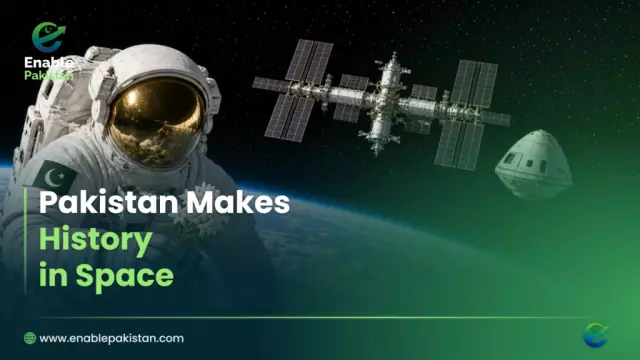
A Pakistani astronaut will join China's Shenzhou-24 crew as a payload specialist, the China Manned Space Agency said on Saturday, November 7, 2026. After a short flight in orbit, that astronaut is to come home on the Shenzhou-23 spacecraft. China says the visit will make the astronaut the first foreign national to board the Tiangong space station, and the first joint flight of Chinese and foreign astronauts in the history of China's crewed space programme.
Who the Pakistani astronaut candidates are
China has not named the person who will fly. The China Manned Space Agency says one of two candidates will take the seat and the other will be the backup. Both finished training in China and passed their assessments.
The two are Muhammad Zeeshan Ali and Khurram Daud. China Daily described them as male Pakistani pilots. Prime Minister Shehbaz Sharif met them on April 23, 2026, and his message, reported by Radio Pakistan, named Wing Commander Muhammad Zeeshan Ali and Commander Khurram Daud. The Prime Minister's post spelled the second name Dawood. The China Manned Space Agency uses Khurram Daud.
The agency announced the pair on April 22, 2026, as the first foreign astronauts selected to train for China's space station. It called that selection a landmark event in the history of China's space industry. Suparco, the Space and Upper Atmosphere Research Commission, said the same day that the two were set to leave for advanced training at the Astronaut Centre of China.
No launch clock time was given in Saturday's statement, and no official account has said which of the two men has the flight seat.
How Pakistan got a seat on the mission
The path started in February 2025, when the China Manned Space Agency and Suparco signed a cooperation agreement in Islamabad. The pact covered selection and training of Pakistani astronauts and a place on a Chinese space-station flight. It opened Pakistan's astronaut selection.
The selection ran in three stages: a preliminary round, a second round, and a final confirmation. Two reserve astronauts came out of that process. The plan from the start was that both would train, one would fly, and one would stand by as backup.
On February 7, 2026, ISPR said the secondary phase of selection was complete. After screening in Pakistan, the Astronaut Centre of China shortlisted two candidates through medical, psychological, and aptitude tests. Their names were not released that day. ISPR said the two would take six months of advanced astronaut training, and that one would then be chosen for a Tiangong flight planned for October or November 2026. On April 22 they were named. On April 23 the Prime Minister received them and congratulated them, saying the selection showed the talent of Pakistan's people and the growing Pakistan-China cooperation in space. Suparco said he called the step a harbinger of deep space exploration and another sign of Pakistan-China friendship.
Suparco also said, in April, that Pakistan was preparing for its first participation in a mission to the China Space Station, then planned for late 2026.
What the training in Beijing covered
The two entered the Astronaut Center of China on China Space Day, April 24, 2026, and trained alongside Chinese astronauts. On May 23, agency spokesperson Zhang Jingbo briefed reporters at the Jiuquan Satellite Launch Center in northwest China, at a press conference tied to the Shenzhou-23 launch. He said the related work was progressing smoothly.
Under the plan he described, one Pakistani astronaut would be a payload specialist on a short spaceflight. The training at that stage was basic training and aerospace technical training, aimed at hands-on skill so the astronaut could carry out the mission. The early phase also included intensive Putonghua, both everyday Chinese and the command words used in a flight. The agency's account of the same briefing added core training, Chinese for daily operations, and in-orbit coordination.
Saturday's statement says that training is now complete and that both candidates passed the evaluation. The flight assignment itself is still not public.
How the Shenzhou-24 flight is planned
Shenzhou-24 is the ship that takes the Pakistani astronaut up. The stay is short. Xinhua called it a short on-orbit flight. China Daily said several days. The return is not on the same ship. The astronaut comes back to Earth on Shenzhou-23, the crewed ship already tied to the station. That is a short visiting flight: go up with the new crew, come home on the spacecraft that is already there. It is not the long stay of the Chinese crew who remain on board.
Separate reporting on the mission logo said Shenzhou-24 is expected in late November, on a six-month flight that takes over from the Shenzhou-23 crew and keeps people aboard Tiangong. That six-month figure is the station rotation. It is not the Pakistani astronaut's stay. The China Manned Space Agency's Saturday statement did not give a launch date.
The job title is payload specialist. When the mission was first set out, the agency said the Pakistani astronaut would help with daily work on the station and carry out scientific experiments for Pakistan. Suparco's April statement said those experiments would be done in microgravity and would cover material science, fluid physics, life and bioscience, and biotechnology, with possible uses in climate resilience, food security, and industrial work. Saturday's announcement did not publish a new experiment list.
Tiangong has been operating since 2021 and, until this flight, has had only Chinese crews. China Daily described it as the only operating space station built independently by one country.
Why the mission mark carries jasmine
The agency released the Shenzhou-24 mission emblem the same day. Its official description uses Earth as the background and shows the Shenzhou-24 crew ship meeting and docking with the space station. Two semicircles frame the scene. The upper one is deep blue, for the open sky and the aim of spaceflight. The lower one is red, for the drive to build China as a space power. Inside the lower arc is a shape taken from an ancient Chinese dragon-patterned jade pendant. Stars sit on both sides of Earth. The year "2026" and the code "SZ-24" mark the mission.
Chinese state media, including a CCTV account carried by Beijing Daily, pointed to one more detail: the SZ-24 lettering is decorated with jasmine, Pakistan's national flower. The report said that flower will go to Tiangong with the Pakistani astronaut.
What the flight would change for Pakistan
China Daily set the flight against the highest point a Pakistani had reached before it. On October 6, 2023, polar adventurer and artist Namira Salim flew a 55-minute suborbital trip with Virgin Galactic and reached about 87.4 kilometres. The paper noted the Karman line, widely used as the start of outer space, at 100 kilometres. Salim's flight stayed below that line. A seat on Tiangong would be an orbital flight and the first time a Pakistani astronaut has lived and worked on a space station.
That is the history in Saturday's announcement. One Pakistani astronaut, still not named in public, is assigned to fly. The other of Zeeshan Ali and Khurram Daud remains the backup. The ship up is Shenzhou-24. The ship home is Shenzhou-23. The stay is short. The station is Tiangong. And the mission mark carries jasmine beside SZ-24.
Our verdict
China has assigned a Pakistani astronaut to Shenzhou-24 as a payload specialist and the first foreign visitor to Tiangong, with a short stay and a return on Shenzhou-23. Muhammad Zeeshan Ali and Khurram Daud are the trained candidates. The agency has not said which one will fly, and it has not given a launch date.
Follow for more updates.
- #Enable Pakistan
- #Khurram Daud
- #Pakistani astronaut
- #Shenzhou-24 Pakistani astronaut
- #Tiangong space station
- #Muhammad Zeeshan Ali
Written by
Enable PakistanGet stories like this in your inbox
The day's top stories, every morning. Free, unsubscribe any time.